
Introduction
For any textile manufacturer in India, buying a circular knitting machine is not only a machinery purchase; it is a long-term production investment. The machine you choose will directly affect fabric quality, GSM consistency, productivity, downtime, maintenance cost, and customer satisfaction. That is why the question “What is the circular knitting machine price in India?” does not have one fixed answer.
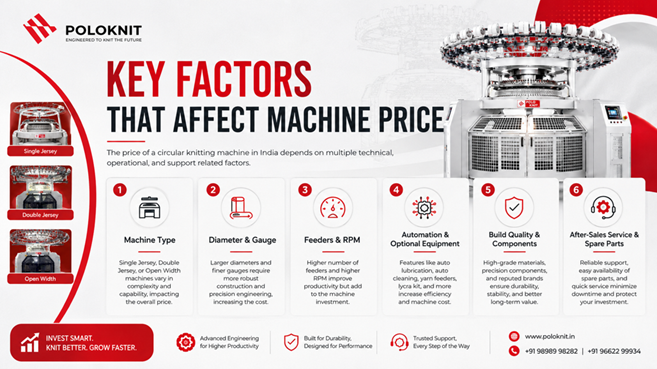
The price depends on machine type, diameter, gauge, feeder count, automation, build quality, optional equipment, spare parts availability, and after-sales service. A low initial price may look attractive, but if the machine creates fabric defects or stops frequently, the real cost becomes much higher. This guide explains the major factors that affect circular knitting machine cost and how Indian textile businesses can make a smarter buying decision.
Why Circular Knitting Machine Price Varies?
Circular knitting machines are available in different configurations for different fabric applications. A machine used for basic t-shirt fabric will not have the same specifications as a machine used for Lycra stretch fabric, rib fabric, interlock fabric, jacquard patterns, or open-width production. Because every fabric requirement is different, the machine design, mechanical setup, feeding system, control system, and optional attachments also change.
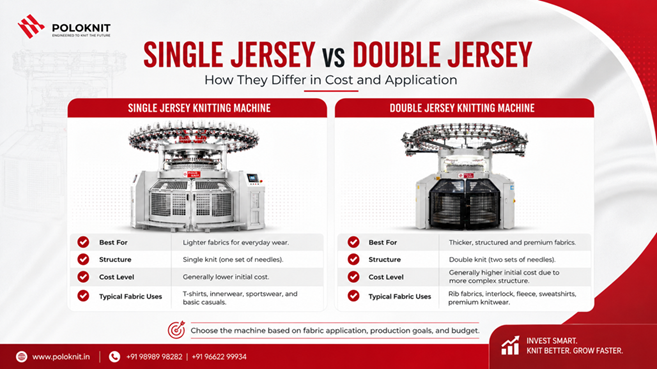
For example, Single Jersey machines are widely used for lightweight knitted fabrics, while Double Jersey machines are built for more structured fabrics. Open Width machines are preferred where fabric roll quality and crease control are important. Computerised Jacquard machines require more advanced control systems for design-based fabric production. Naturally, each machine category has a different cost structure.
1. Machine Type: Single Jersey, Double Jersey, Jacquard or Open Width
The first and most important price factor is the machine type. A Single Jersey circular knitting machine is generally suitable for t-shirts, innerwear, sportswear, kidswear, casualwear, and lightweight fabric production. It is often a practical choice for manufacturers who want high production with flexible fabric applications.
A Double Jersey circular knitting machine is usually more complex because it works with two sets of needles and is used for rib, interlock, thicker fabrics, sweatshirts, and structured knitwear. Due to its additional components and more complex knitting structure, its cost is generally higher than a basic Single Jersey machine. Jacquard and Open Width machines can cost more depending on the automation, electronic selection system, fabric output requirement, and finishing needs.
2. Diameter, Gauge and Feeders
Machine diameter and gauge also play a major role in pricing. Diameter affects the fabric tube width and production planning, while gauge affects fabric fineness and structure. A finer gauge usually requires more precision engineering, accurate needle arrangement, and high-quality components. This can increase the overall machine cost.
The number of feeders also affects production capacity. Higher feeder count can improve output, but it requires a more advanced and stable feeding arrangement. Similarly, RPM matters because high-speed running demands better balancing, stronger frame construction, precision bearings, proper lubrication, and reliable mechanical design. A machine built for stable high-speed production will usually have a higher upfront cost, but it can offer better productivity in the long run.
3. Automation and Optional Equipment
Modern textile units prefer machines with useful automation because it reduces manual dependency and improves control over production. Features such as inverter speed control, production display, auto lubrication, yarn feed stop motion, needle break detectors, automatic cleaning devices, and yarn creel systems add value to the machine.
For Lycra and stretch fabric production, equipment such as Lycra kit, Lycra feeding units, and yarn input measuring devices may be required. Open Width systems and machine networking options can also increase cost, but they help improve fabric handling, production monitoring, and consistency. The right automation should be selected based on actual fabric application, not only on budget.
4. Build Quality and Core Components
The real strength of a circular knitting machine is inside its frame, cylinder, cam system, gears, needles, sinkers, bearings, and drive mechanism. A strong cast iron frame, precise drive system, stable cylinder support, high-quality cams, and proper lubrication help the machine run smoothly and reduce wear over time.
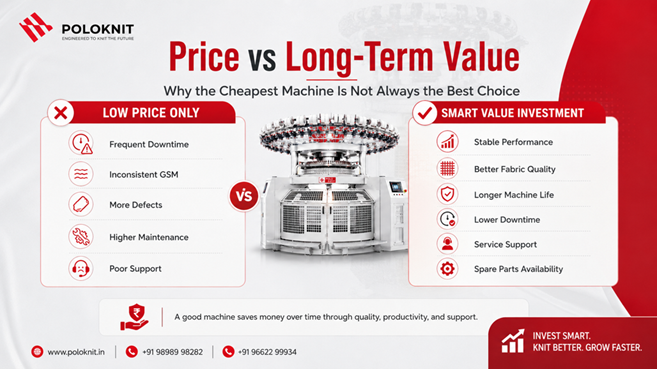
Cheaper machines may save money during purchase, but low-quality components can lead to vibration, needle breakage, uneven loops, GSM variation, oil leakage, noise, and frequent maintenance. In textile production, even small fabric defects can create major losses when production volume is high. Therefore, build quality should always be considered along with price.
5. After-Sales Service, Training and Spare Parts
After-sales support is one of the most important factors for Indian textile manufacturers. A machine can perform well only when it is installed properly, maintained correctly, and supported quickly during breakdowns. Installation, commissioning, operator training, spare parts availability, and responsive service can protect your investment and reduce downtime.
When comparing circular knitting machine price in India, buyers should not compare only the machine quotation. They should also evaluate whether the supplier provides technical guidance, correct machine selection, training, spare parts, and long-term service support. A slightly higher investment with dependable support can be more profitable than a low-cost machine with poor service backup.
How to Plan Your Machine Budget?
Before asking for price, manufacturers should first define their fabric requirement. Important details include fabric type, yarn count, GSM range, fabric width, stretch requirement, production target, finishing process, and application such as t-shirt fabric, innerwear fabric, sportswear, Lycra fabric, rib fabric, or interlock fabric. Once these details are clear, the supplier can suggest the right machine configuration.
A good machine investment should balance price, quality, productivity, fabric consistency, service support, and future expansion. The cheapest machine is not always the most economical machine. The best machine is the one that produces consistent fabric, runs steadily, reduces downtime, and supports business growth.
Why Choose Poloknit?
Poloknit focuses on circular knitting machinery for Indian textile manufacturers, with machine options for Single Jersey, Double Jersey, Jacquard, and Open Width applications. The company supports customers with machine selection, installation, commissioning, training, spare parts, and after-sales service. This customer-first approach helps factories modernize, expand, and run smarter.
For manufacturers in Surat and across India, Poloknit aims to provide not only machines but also practical guidance based on fabric application, GSM requirement, production planning, and long-term value. Whether you are starting a new knitting unit or upgrading an existing setup, choosing the right circular knitting machine can make a major difference in fabric quality and profitability.
Conclusion
Circular knitting machine price in India depends on many technical and commercial factors. Machine type, diameter, gauge, feeders, RPM, automation, build quality, optional equipment, service support, and spare parts availability all affect the final investment. Instead of buying only on low price, textile manufacturers should focus on long-term value, stable production, consistent fabric quality, and dependable after-sales support.