Introduction
Buying an embroidery machine is a big investment for any textile business in India. Whether you are a fabric manufacturer, garment unit, embroidery job worker, boutique supplier, saree manufacturer, or fashion textile business, the most important question is always the same: “How long will it take to recover the investment after purchasing the machine?”
This is called ROI – Return on Investment. In simple words, ROI means how much profit your machine can generate compared to the money you invested in it. A good embroidery machine should not only look attractive in terms of features. It should help your business increase production, improve design quality, reduce wastage, complete orders on time, and generate regular income.
Before buying any embroidery machine in India, every buyer should understand machine cost, production capacity, running expenses, job work rate, maintenance, labour cost, and expected monthly profit. This blog will help you understand how to calculate embroidery machine ROI in a practical way.
What Is ROI in Embroidery Machine Business?
ROI means the time required to recover your machine investment from your business profit. For example, if you invest in an embroidery machine and your monthly net profit from that machine is consistent, you can calculate how many months it will take to recover your total investment.
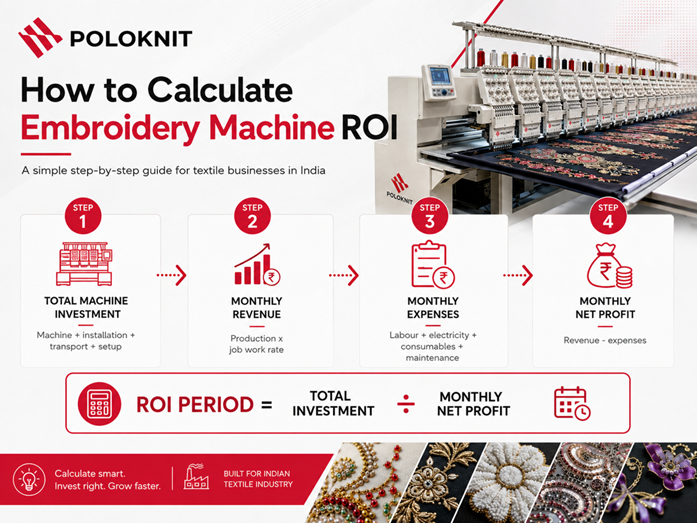
The basic formula:
ROI Period = Total Machine Investment ÷ Monthly Net Profit
For example, if your total investment is ₹20,00,000 and your monthly net profit is ₹2,00,000, then your approximate investment recovery period is:
₹20,00,000 ÷ ₹2,00,000 = 10 months
This is only an example. Actual ROI depends on your machine type, production volume, design category, market demand, operator skill, order flow, and running cost.
Step 1: Calculate Total Machine Investment
The first step is to calculate the total cost of starting production. Many buyers only consider the machine price, but actual investment may include multiple expenses.
Your total investment may include:
- Machine cost
- Installation cost
- Transportation cost
- Operator training
- Basic spare parts
- Power setup
- Workspace preparation
- Design/software support
- Initial maintenance setup
When you calculate ROI, always include the complete investment amount. This gives you a more realistic picture of your business recovery time.
Step 2: Estimate Monthly Production Capacity
The second step is to understand how much production your embroidery machine can give in one month. Production depends on machine speed, number of heads, embroidery design size, stitch count, fabric type, operator efficiency, and working hours.
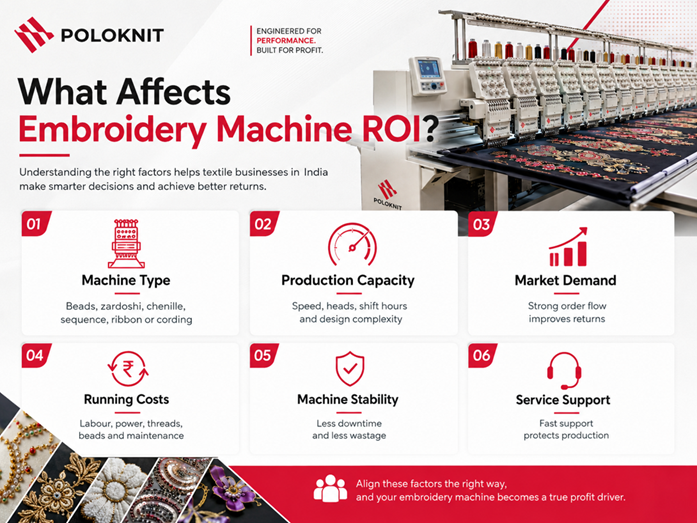
For Indian textile units, production can vary greatly. A simple sequin design may complete faster, while heavy zardoshi, bead, chenille, ribbon, or cording work may take more time. This is why choosing the right machine type is very important.
Poloknit offers different embroidery machine options such as bead embroidery, zardoshi + beads, chenille, beads + ribbon, triple sequence, and twin sequence + cording machines. Each machine is suitable for different production needs and design applications.
Step 3: Calculate Monthly Revenue
After estimating production, you need to calculate monthly revenue. This depends on whether you are doing job work or producing your own fabric/garments.
If you are doing embroidery job work, your revenue depends on your job work rate and quantity completed. If you are producing your own sarees, fabrics, garments, dress materials, or fashion products, then embroidery adds value to the product and helps you sell at a better margin.
Basic revenue formula:
Monthly Revenue = Total Monthly Production × Average Job Work Rate
For example, if your machine completes 10,000 pieces or design units in a month and your average earning is ₹30 per unit, then: 10,000 × ₹30 = ₹3,00,000 monthly revenue
This is only a sample calculation. Every business should replace this with its actual production and market rate.
Step 4: Deduct Monthly Expenses
Revenue is not profit. To calculate real embroidery machine profit, you must deduct monthly expenses.
Common monthly expenses include:
- Operator salary
- Helper salary
- Electricity cost
- Thread, needle, sequin, bead, ribbon, and consumables
- Maintenance cost
- Rent or factory overhead
- Designing cost
- Wastage and rejection cost
Formula:
Monthly Net Profit = Monthly Revenue – Monthly Expenses
For example, if your monthly revenue is ₹3,00,000 and your monthly expenses are ₹1,20,000, then:
₹3,00,000 – ₹1,20,000 = ₹1,80,000 monthly net profit
Now you can calculate ROI:
Total Investment ÷ Monthly Net Profit = ROI Period
Why Machine Stability Improves ROI?
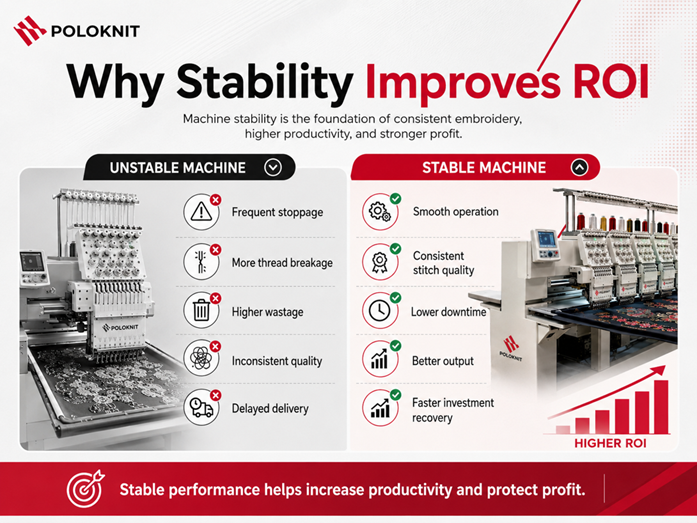
Many buyers compare only machine price and speed, but machine stability has a direct impact on ROI. A machine that stops frequently, creates uneven stitches, breaks thread, or gives inaccurate placement can reduce production and increase wastage.
Stable embroidery machines help in:
- Better production continuity
- Less wastage
- Cleaner embroidery finishing
- Higher operator confidence
- Consistent stitch quality
- On-time order delivery
- Better customer satisfaction
For heavy production, stability and smooth operation are more valuable than just low initial cost. A slightly better machine with dependable output can recover investment faster because it reduces hidden losses.
Choosing the Right Machine for Better ROI
The right embroidery machine depends on your target market. If your customers demand traditional ethnic work, zardoshi + beads embroidery can be a strong option. If your market is fashion fabric and designer garments, chenille, sequence, ribbon, and cording machines can add premium design value.
For bulk production, multi-head machines can improve output and reduce per-piece labour cost. For specialty embroidery, advanced machines can help you offer unique designs and charge better rates.
Before buying, ask these questions:
- What type of embroidery has demand in my market?
- What is my daily production target?
- Do I have regular job work or own product sales?
- What rate can I charge per design or per piece?
- How much maintenance and service support will I get?
Why Poloknit Embroidery Machines Are Suitable for Indian Businesses?
Poloknit understands the needs of Indian textile manufacturers, especially production-focused businesses in Surat, Gujarat, and across India. Poloknit embroidery machines are designed for precision, stable high-speed performance, smooth operation, accurate placement, consistent stitch quality, and professional output.
With machine options for beads, zardoshi, chenille, ribbon, sequence, and cording embroidery, Poloknit helps textile businesses choose the right machine according to their production requirement. Along with machine selection, proper guidance, installation support, technical understanding, and service support are important for long-term ROI.
Conclusion
Embroidery machine ROI in India depends on many factors: machine investment, production capacity, job work rate, running expenses, machine stability, operator skill, and market demand. Before buying, do not focus only on price. Focus on long-term profit, production quality, service support, and machine reliability.
A good embroidery machine can become a strong profit-generating asset for your textile business. If you are planning to invest in an embroidery machine, connect with Poloknit for the right guidance and machine selection.