
Introduction
In embroidery production, even a small machine problem can disrupt the full workflow of a textile business. One broken thread, one damaged needle, one shifting design, or one hour of machine downtime can affect delivery time, fabric quality, operator confidence, and profit. For Indian embroidery job workers, garment units, saree manufacturers, boutique suppliers, and fashion fabric producers, avoiding production loss is as important as getting new orders.
Embroidery machines work with high speed, multiple needles, thread paths, frames, fabrics, sequins, beads, ribbons, and design files. Because of this, correct machine settings and regular care are necessary. If problems are ignored, they can create wastage, rework, customer rejection, and unnecessary maintenance costs. This blog explains common embroidery machine problems and practical ways to reduce them in daily production.
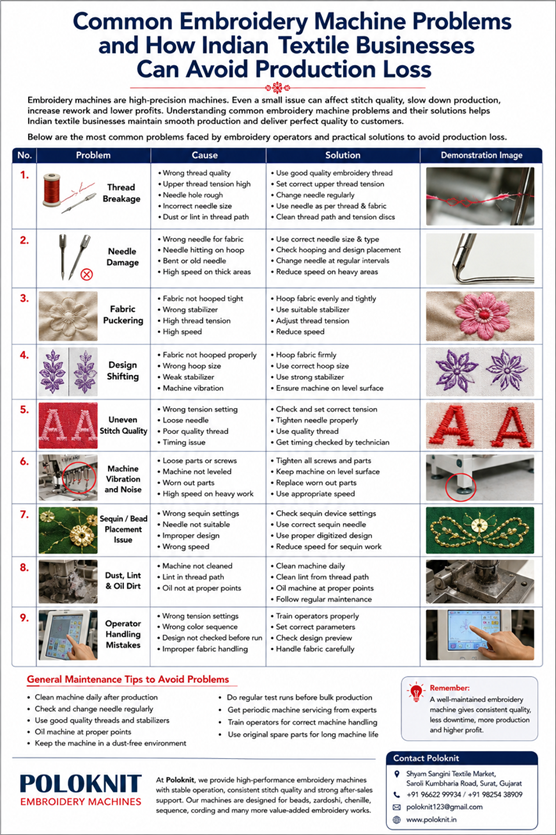
1. Thread Breakage
Thread breakage is one of the most common problems in embroidery production. It can happen because of incorrect thread tension, poor thread quality, rough needle holes, dust in the thread path, wrong needle size, or high machine speed on difficult designs. Every break stops production and wastes operator time.
To reduce thread breakage, use good-quality embroidery thread, set the correct tension, clean the thread path regularly, and replace damaged needles on time. Match the needle, thread, and fabric according to the design for smoother bulk production.
2. Needle Damage
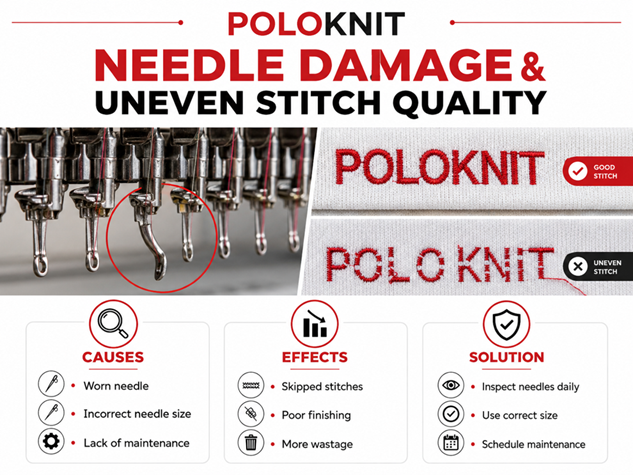
A bent, blunt, or incorrect needle can damage fabric, break thread, create skipped stitches, and spoil embroidery finishing. Needle damage can happen due to long usage, wrong size, poor-quality needles, high speed on thick areas, or the needle hitting the hoop.
Inspect needles daily and replace them regularly. Use the correct needle type for the fabric and application. For heavy work like beads, zardoshi, chenille, sequence, and cording, needle setup should be checked before starting bulk production.
3. Fabric Puckering
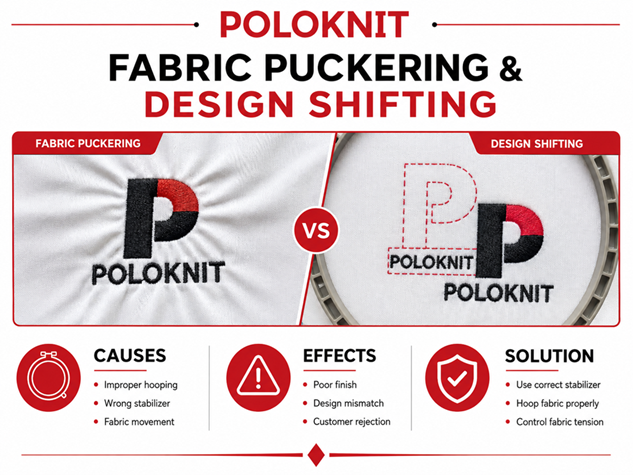
Fabric puckering means the fabric gathers, wrinkles, or pulls around the embroidery design. It usually happens when fabric is not hooped properly, the stabilizer is weak, thread tension is high, or the design is too dense for the fabric.
To avoid puckering, hoop the fabric evenly, use the correct stabilizer, adjust thread tension, and choose suitable design density. For delicate or stretchable fabrics, extra care is required because fabric movement can quickly affect the embroidery shape.
4. Design Shifting
Design shifting happens when the embroidery design does not stitch in the correct position. The outline and fill may not match, letters may move, or decorative areas may look misaligned. Loose hooping, wrong frame size, weak stabilizer, machine vibration, or fabric movement are common reasons.
To prevent design shifting, hoop the fabric firmly, check placement, use the correct frame, and keep the machine on a level surface. Before a large order, take a test run on the same fabric to avoid bulk rejection.
5. Uneven Stitch Quality
Uneven stitches make embroidery look unprofessional. The design may appear loose, rough, too tight, or inconsistent across heads. Common reasons include wrong tension, poor thread, loose needle, timing issues, dust, or lack of maintenance.
To improve stitch quality, check thread tension, clean the machine, use quality thread, tighten loose needles, and schedule technical maintenance. A stable machine with smooth movement helps produce cleaner embroidery with uniform results.
6. Machine Vibration, Noise, and Downtime
Machine vibration and abnormal noise should never be ignored. They can indicate loose screws, worn-out parts, poor leveling, lack of oiling, or high-speed running on heavy embroidery work. If these problems continue, they can lead to downtime and production loss.
Regular preventive maintenance is the best solution. Keep the machine clean, lubricate required parts, tighten loose parts, and call technical support when unusual sounds or movement appears. Less downtime means better output and stronger profit.
7. Sequin, Bead, Ribbon, and Cording Placement Issues
Special embroidery work like sequin, bead, ribbon, zardoshi, chenille, and cording requires accurate placement. If the setting is wrong, the design may look uneven, or the decorative element may not sit properly on the fabric.
Before production, check device settings, needle suitability, design digitizing, and machine speed. Poloknit offers machine options for 3/4/5 beads, zardoshi + beads, chenille, beads + ribbon, triple sequence, and twin sequence + cording applications, helping manufacturers select the right machine for their work.
8. Operator Handling Mistakes
Even a good embroidery machine needs a trained operator. Wrong tension setting, wrong color sequence, improper hooping, wrong design selection, or careless fabric handling can create repeated issues.
Before every order, operators should check the design file, fabric, thread, needle, hooping, color sequence, and sample output. A clear production checklist reduces mistakes and improves consistency.
Why Poloknit Focuses on Stability and Support
For Indian textile businesses, the right embroidery machine is not only about speed. It is about stable high-speed performance, accurate placement, consistent stitch quality, smooth operation, and reliable output. Poloknit understands practical production needs in Surat, Gujarat, and across India.
With proper machine selection, installation guidance, operator understanding, spare parts support, and service support, embroidery businesses can reduce hidden losses and improve productivity. A well-maintained and stable machine becomes a profit-generating asset for the factory.
Conclusion
Common embroidery machine problems such as thread breakage, needle damage, fabric puckering, design shifting, uneven stitches, vibration, downtime, and placement issues can affect production quality and profit. Most of these problems can be reduced with proper setup, regular maintenance, trained operators, quality consumables, and timely technical support.
If you are planning to upgrade embroidery production or select the right machine for your textile business, connect with Poloknit for professional guidance and machine solutions.