
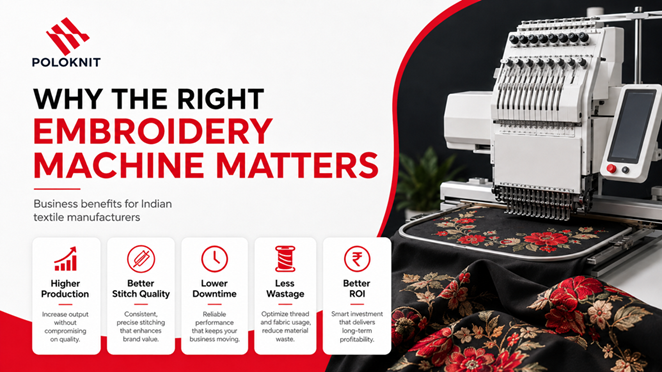
Buying an embroidery machine is a major decision for any textile business. Whether you are a garment manufacturer, saree producer, fabric job worker, boutique supplier, fashion brand, or embroidery unit owner, the right machine can help you increase production, improve design quality, reduce wastage, and grow profit.
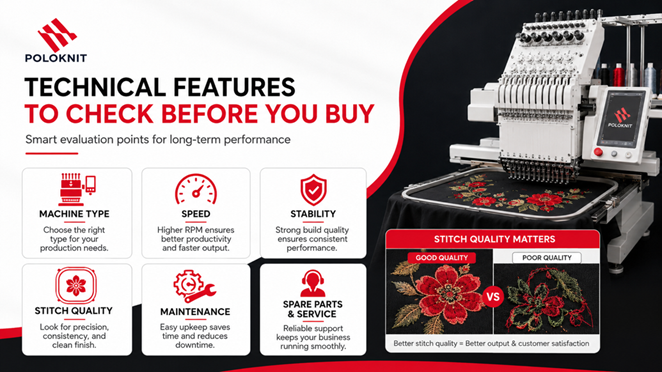
But many buyers make one common mistake: they compare only price. In reality, an embroidery machine should not be selected only by cost. You must check machine type, speed, stability, stitch quality, service support, spare parts, production requirements, and long-term return on investment.
In India, embroidery is used widely in sarees, lehengas, dress materials, ethnic wear, fashion garments, uniforms, patches, labels, and value-added fabrics. That is why choosing the right machine is very important. Before buying an embroidery machine, check these 10 important points.
1. Understand Your Embroidery Requirements
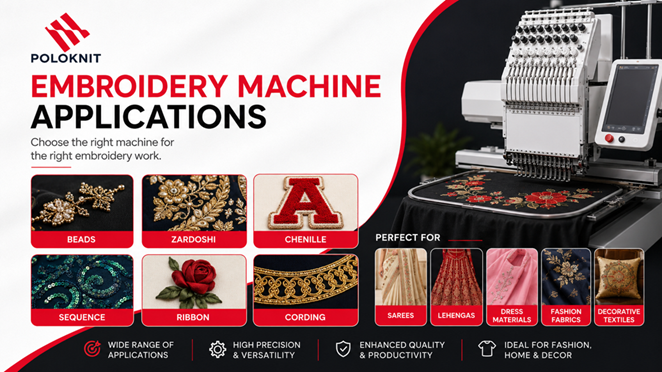
Before selecting any machine, first understand what type of embroidery work you want to produce. Every business has different requirements. Some manufacturers need bead work, some need zardoshi, some need chenille texture, while others need sequin, ribbon, or cording embroidery.
If your main work is ethnic wear, bridal wear, sarees, or lehengas, you may need machines suitable for zardoshi, beads, and sequence work. If your focus is fashion fabric or decorative designs, chenille, ribbon, and cording machines can add more value.
Do not buy a machine just because someone else is using it. Buy according to your own product category, market demand, and production target.
2. Check Machine Type and Application
Different embroidery machines are built for different applications. A basic machine may not be suitable for advanced value-added embroidery. Before investing, check whether the machine supports the design effects your customers demand.
Poloknit offers embroidery machine options such as 3/4/5 beads high-speed embroidery machines, zardoshi + beads machines, chenille embroidery machines, beads + ribbon machines, triple sequence machines, and twin sequence + cording machines. These categories help textile businesses produce different types of premium embroidery work.
Choosing the correct embroidery machine type helps you avoid future limitations and allows you to accept more design-based orders.
3. Check Production Capacity
Production capacity is one of the most important points before buying an embroidery machine. You should calculate how much production you need daily or monthly. A small business, job worker, and large production unit will not have the same requirement.
Ask yourself: How many hours will the machine run per day? What type of designs will I produce? Will I handle small batches or bulk orders? Will I work for local customers or large brands?
A machine with the right production capacity can help you complete orders on time and reduce delivery pressure.
4. Check Machine Speed
Speed matters in embroidery production, but only speed is not enough. Some machines may offer high speed, but if they create thread breakage, vibration, or uneven stitch quality, your actual output will reduce.
A good embroidery machine should offer stable high-speed performance. Depending on the machine type, Poloknit embroidery machines offer speed options suitable for professional production. Buyers should always check whether the machine can maintain quality while running at production speed.
High speed is useful only when the machine also gives consistent output.
5. Check Machine Stability
Machine stability directly affects embroidery quality and production efficiency. If the machine vibrates too much, it can cause design shifting, uneven stitches, thread breakage, needle damage, and fabric wastage.
For heavy embroidery production, stability is one of the most important factors. A stable machine gives smooth operation, better stitch formation, accurate placement, and lower downtime.
Before buying, check the machine body, frame strength, movement accuracy, and overall build quality. A stable machine may give better long-term profit than a low-cost machine with frequent problems.
6. Check Stitch Quality and Finishing
Embroidery is all about appearance and finishing. If stitch quality is poor, the final product will not look premium. Customers can easily notice loose threads, uneven filling, broken lines, poor outlines, and design mismatch.
Good stitch quality depends on machine accuracy, thread tension, needle movement, fabric holding, and operator control. For bead, zardoshi, chenille, sequence, ribbon, and cording work, accurate placement is especially important.
Before buying, always check sample output. See whether the embroidery looks clean, balanced, and professional.
7. Check Maintenance Requirements
Every embroidery machine needs regular maintenance. But the machine should not require too much frequent repair. If maintenance is complicated or spare parts are not easily available, your production can stop.
Ask the supplier about daily cleaning, oiling, needle replacement, tension checking, and the service schedule. Also check whether your operator can easily maintain the machine with basic training.
A well-maintained machine gives longer life, better performance, fewer breakdowns, and consistent production quality.
8. Check Spare Parts Availability
Spare parts availability is very important for Indian textile businesses. If one small part is not available on time, your machine may remain stopped for days. This can affect production, delivery, and profit.
Before buying, ask whether spare parts are available locally or can be supplied quickly. Also check whether the supplier provides technical guidance for part replacement and maintenance.
Reliable spare parts support gives confidence to run the machine for long working hours.
9. Check Installation, Training, and Service Support
After-sales support is one of the biggest factors when buying an embroidery machine. A machine is not only a product; it is a production system. Proper installation and operator training are necessary for smooth performance.
If operators are not trained properly, they may make mistakes in tension setting, hooping, thread selection, speed control, and design handling. This can create production losses.
Choose a machinery partner who can guide you before and after purchase. Poloknit focuses on helping buyers with machine selection, installation support, technical understanding, and service support for professional embroidery production.
10. Check ROI Before Final Decision
Before buying any embroidery machine, calculate ROI. ROI means how quickly your investment can be recovered from machine profit. You should calculate machine cost, monthly production, job work rate, labour cost, electricity cost, maintenance cost, and expected net profit.
Do not choose a machine only because it is cheaper. A machine with better stability, output, support, and long working life can give better ROI in the long run.
The right embroidery machine should help you increase production, reduce wastage, improve quality, and accept better-value orders.
Conclusion
Buying an embroidery machine is a long-term business investment. Before making a decision, check machine type, application, production capacity, speed, stability, stitch quality, maintenance, spare parts, service support, and ROI.
For Indian textile businesses, the right machine can improve product value, production efficiency, customer satisfaction, and profit. If you are planning to invest in an embroidery machine, choose a reliable machinery partner who understands your production needs.
Poloknit offers embroidery machine solutions for beads, zardoshi, chenille, ribbon, sequence, and cording applications. With a focus on stable performance, consistent stitch quality, smooth operation, and professional production output, Poloknit helps Indian textile businesses choose the right machine for long-term growth.