
Introduction
Embroidery job work is one of the most practical business opportunities in the Indian textile industry. From sarees and lehengas to dress materials, uniforms, fashion garments, patches and home textiles, embroidery is used to add beauty, premium value and market demand to fabric products.
Many textile businesses do not want to invest in their own embroidery setup at the beginning. They prefer to outsource embroidery to reliable job workers. This creates a strong opportunity for entrepreneurs who can provide good quality embroidery, timely delivery, and consistent finishing.
But starting an embroidery job work business is not only about buying a machine. You need to understand your market, choose the right services, calculate costing, maintain stitch quality, train operators, and build repeat customers. This blog explains the important steps to start an embroidery job work business in India.
What Is an Embroidery Job Work Business?
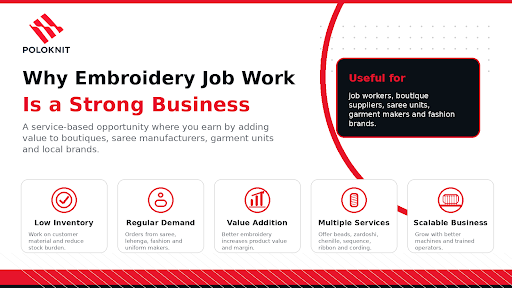
In embroidery job work, you provide embroidery services on customer-supplied fabric, garments or panels. The customer may be a saree manufacturer, boutique, garment unit, fashion brand, uniform supplier, trader or export house. Your earnings come from the embroidery work done on each piece, meter, panel, or design.
This business is service-based, so you do not always need to hold large finished-goods inventory. Your main focus is production quality, design accuracy, machine performance, and delivery commitment.
Why Embroidery Job Work Has Demand in India?
India has a strong culture of decorative textiles. Sarees, lehengas, ethnic wear, festive garments and bridal products often need zardoshi, beads, sequins, chenille, ribbon, cording or thread embroidery. At the same time, modern fashion brands need logo embroidery, patches, monograms, kidswear designs and decorative garment details.
Because embroidery increases the selling value of a product, many manufacturers look for job workers who can provide clean finishing and dependable output. If you can maintain quality and delivery, you can build regular business with local textile markets and garment manufacturers.
1. Decide Your Target Customer
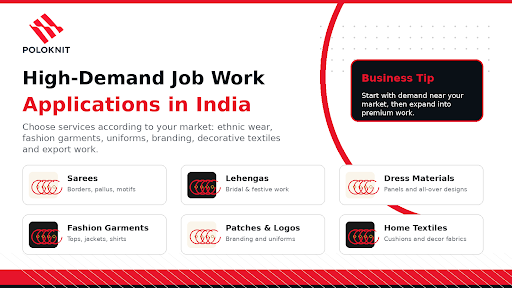
Before starting, decide whom you want to serve. Your target customers may include saree manufacturers, lehenga makers, dress material traders, boutique owners, garment factories, school uniform suppliers, corporate uniform vendors or fashion brands.
For example, if your area has strong saree and ethnic-wear production, zardoshi, beads and sequence work may have higher demand. If your market is garment-focused, logo embroidery, patches, chenille, and fashion designs may be more useful.
2. Choose the Right Embroidery Service
Do not start with every service at once. Select the services that match your local demand and budget. Common embroidery job work categories include beads, zardoshi, chenille, ribbon, sequence, cording and regular thread embroidery.
Poloknit embroidery machine options include 3/4/5 beads high-speed embroidery machines, zardoshi + beads machines, chenille embroidery machines, beads + ribbon machines, triple sequence machines, and twin sequence + cording machines. Choosing the right embroidery machine type helps you accept the right orders and avoid production limitations.
3. Select the Right Machine and Production Capacity
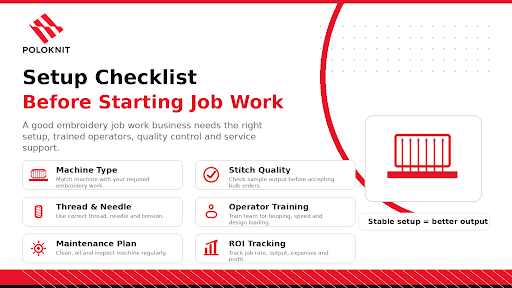
Your embroidery machine should match your expected order volume. A small job worker may start with limited capacity, while a production-focused unit may need a higher-capacity setup. Check machine speed, number of heads, application type, stability, stitch quality, service support, and spare parts availability before investing.
Do not buy only by comparing price. A stable machine with consistent stitch quality can reduce downtime, wastage, and rework. This directly improves your profit and customer satisfaction.
4. Plan Workspace, Power, and Operator Setup
Embroidery production needs a clean and organized workspace. Keep enough space for fabric handling, hooping, design checking, thread storage, packing, and finished work inspection. Dust control is also important because dust and lint can affect thread movement and machine performance.
Train operators properly in hooping, tension setting, needle selection, design loading, speed control and daily cleaning. A trained operator can reduce mistakes and improve production efficiency.
5. Learn Embroidery Job Work Costing
Costing is very important in this business. Your rate should cover thread, needle, consumables, electricity, labour, maintenance, rent, machine investment and profit. Rates can be calculated per piece, per panel, per meter, per stitch count, or per design complexity, depending on the market.
Always calculate your monthly production, total expenses and expected profit. This helps you understand ROI and avoid taking orders at loss-making rates.
6. Maintain Quality and Delivery
Customers return to job workers who give consistent quality. Check stitch finishing, thread trimming, fabric puckering, design placement, colour matching, and overall appearance before delivery. For heavy work like beads, zardoshi, sequence or cording, placement accuracy is very important.
Maintain your machine regularly. Daily cleaning, correct oiling, needle replacement, and timely technical service help reduce breakdowns and protect delivery schedules.
7. Find Customers and Build Repeat Orders
Start by approaching nearby textile traders, boutiques, garment units, saree and lehenga manufacturers, uniform suppliers, and fabric markets. Keep sample designs ready to show your work quality. You can also use WhatsApp Business, Instagram, Google Business Profile, LinkedIn, and IndiaMART to show your work and generate leads.
Customer trust grows when you deliver on time, communicate clearly, and maintain sample-level quality in bulk production.
Why Choose Poloknit?
Poloknit supports Indian textile businesses with embroidery machine solutions designed for stable performance, smooth operation, consistent stitch quality and professional production output. Based in Surat, Poloknit understands the needs of job workers, fabric manufacturers, garment units, and embroidery business owners across India.
With options for beads, zardoshi + beads, chenille, beads + ribbon, triple sequence and twin sequence + cording embroidery, Poloknit helps buyers choose machines according to their business requirement.
Conclusion
Starting an embroidery job work business in India can be a profitable opportunity when planned properly. The key is to choose the right market, right service, right machine, right costing and right quality system.
If you are planning to start or expand embroidery job work, connect with Poloknit for machine guidance, technical understanding, and professional support.