Introduction
Surat is one of India’s most important textile cities and a strong business destination for fabric traders, garment manufacturers, wholesalers, sourcing teams, and new textile entrepreneurs. The city has built a complete ecosystem where production, processing, wholesale trading, transport, and buyer movement work closely together.
For anyone planning to enter the fabric or garment business, Surat offers practical advantages: variety, speed, supplier availability, business networking, and access to different textile segments. From sarees and dress materials to man-made fabrics, fashion fabrics, grey fabric, processed fabric, and garment-ready material, Surat has become a preferred market for buyers from many parts of India.
The biggest strength of Surat Textile Market is not only its size, but its connected ecosystem. A buyer can explore fabrics, meet traders, coordinate production, arrange processing, check quality, and plan dispatch through one city-level network. This is why Surat continues to attract textile business owners, retailers, wholesalers, and fabric manufacturers.
1. Strong Textile Manufacturing and Trade Base
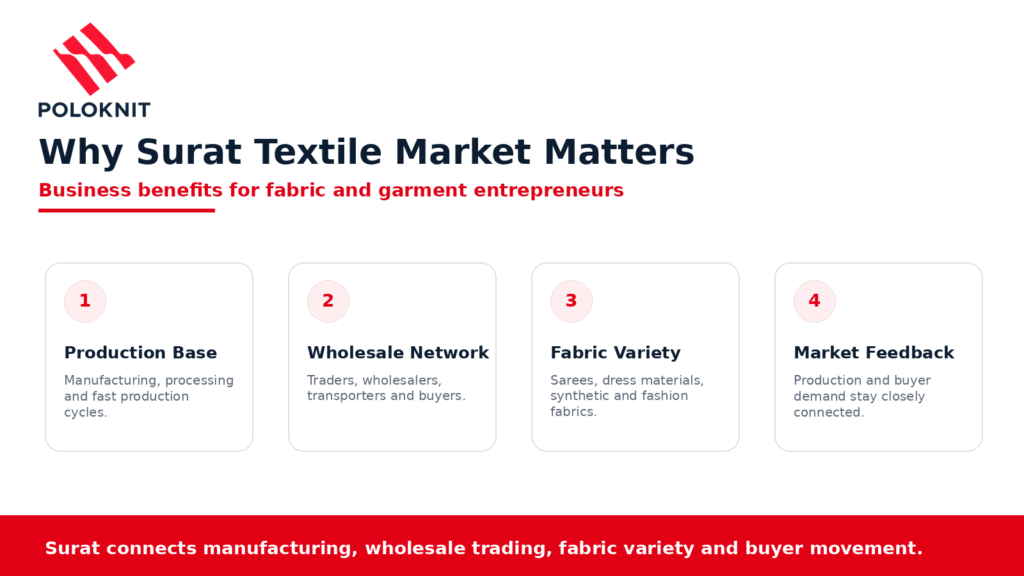
Surat’s economy has a deep connection with textile manufacturing and trade. The city is known for man-made fabric production, textile processing, zari work, trading, and industrial activity. This manufacturing base gives Surat a strong advantage because buyers can connect with suppliers and production sources more easily.
For garment businesses, this means better access to fabric options, faster sampling, quicker decisions, and more flexible sourcing. Instead of depending on distant suppliers for every requirement, many buyers prefer Surat because production and trading activity are closely linked.
A strong production base also helps new entrepreneurs understand market demand faster. They can study what fabric is moving, which qualities are in demand, what price range buyers prefer, and what type of finishing is required.
2. Large Wholesale Network
Surat Textile Market is popular because of its wholesale trading strength. The market connects fabric manufacturers, traders, wholesalers, retailers, garment units, job workers, brokers, and outstation buyers. This kind of network is very useful for both buying and selling.
For fabric sellers, a wholesale network means more buyer exposure. For garment manufacturers, it means better sourcing options. For traders, it means faster movement of stock. The market also supports bulk buying, catalogue-based selling and repeat business relationships.
In the textile industry, trust and network matter a lot. Surat’s market culture helps businesses build long-term vendor and buyer relationships.
3. Wide Fabric Variety
One major reason Surat is a hub is fabric variety. Buyers come to Surat for saree fabrics, dress materials, synthetic fabrics, man-made fabrics, printed fabrics, dyed fabrics, fashion fabrics, and value-added textile products.
This wide variety helps retailers and garment brands create more product options for their customers. A boutique owner, wholesaler, or garment manufacturer can compare multiple qualities, colors, designs, GSM ranges, finishes, and price points in one market.
For new textile entrepreneurs, fabric variety is also useful for market research. They can understand which segment is suitable for their business: budget fabrics, premium fabrics, daily wear, ethnic wear, fashion garments, sportswear, or innerwear-related fabrics.
4. Complete Textile Ecosystem
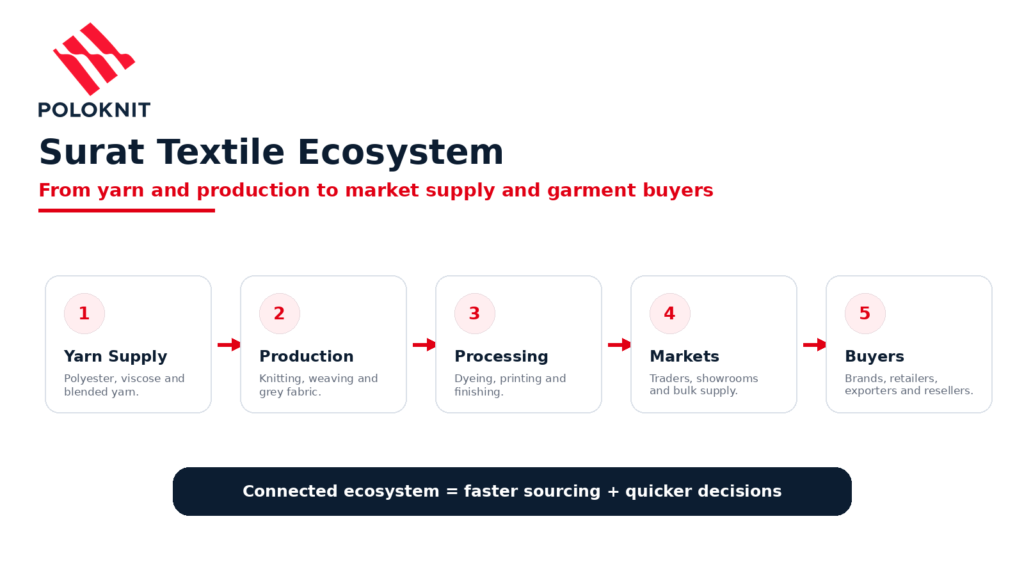
Surat is not only a buying market; it is a full textile ecosystem. The business cycle includes yarn supply, weaving or knitting, grey fabric, dyeing, printing, finishing, wholesale trading, transport, and final buyers. When these stages are available in a connected region, business becomes faster and more efficient.
This ecosystem helps reduce delays because manufacturers and traders can coordinate multiple activities locally. If fabric needs processing, printing, or finishing, related vendors are easier to find. If buyers need transport support, logistics and parcel movement are also part of the market system.
For garment businesses, this connected ecosystem can support faster product development and quicker market response.
5. Faster Market Feedback
In the textile business, market feedback is extremely important. Surat gives traders and manufacturers the benefit of quick feedback because buyers, wholesalers, and retailers are active in the same business environment.
If a design, fabric quality, or price range is working well, the market response can be seen quickly. If a fabric is slow-moving, businesses can adjust production or buying decisions. This speed helps reduce wrong stock planning and improves business confidence.
For new entrepreneurs, this is a major advantage. Surat helps them learn from live market movement instead of guessing demand from a distance.
6. Good Opportunity for Fabric and Garment Businesses
Surat is useful for many types of businesses: fabric traders, garment manufacturers, wholesalers, exporters, retailers, job workers, sourcing agents, and textile machinery buyers. A business can start small and scale gradually by building the right network.
For fabric manufacturers, Surat offers access to buyers and trading channels. For garment manufacturers, it offers fabric sourcing and design variety. For traders, it offers stock movement and wholesale opportunities. For new investors, it gives a practical view of how the textile supply chain works.
7. How to Use Surat Market for Business Growth
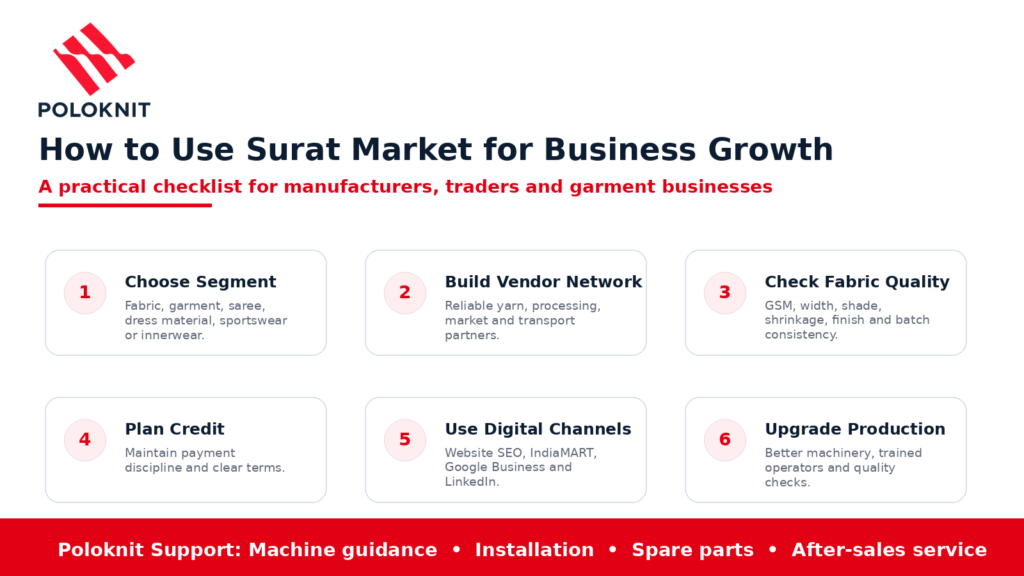
Surat gives opportunity, but success still depends on planning. A business should not enter the market blindly. The right approach is to choose a segment, build vendor relationships, maintain quality, and use digital channels along with offline market networking.
- Choose your segment clearly: fabric, garment, saree, dress material, sportswear, innerwear, or fashion fabric.
- Build a reliable vendor network for yarn, fabric, processing, transport, and finishing.
- Check fabric quality before bulk buying or production.
- Maintain clear payment terms and credit discipline.
- Use digital channels like website SEO, IndiaMART, Google Business Profile, and LinkedIn.
- Upgrade production with better machinery, trained operators, and quality checks.
Why Choose Poloknit?
Poloknit supports textile entrepreneurs and manufacturers with circular knitting machine solutions, machine selection guidance, installation support, operator training, spare parts, and after-sales service.
For businesses planning to manufacture knitted fabric, sportswear fabric, innerwear fabric, Lycra fabric, rib fabric, interlock fabric, or fashion fabric, the right machine and technical guidance can improve production confidence.
Surat’s market gives business opportunities, and Poloknit helps manufacturers build strong production capability to serve that opportunity.
Conclusion
Surat Textile Market is a hub for fabric and garment business because it combines manufacturing strength, wholesale trading, fabric variety, processing support, logistics, and buyer movement. For textile entrepreneurs, this connected environment creates opportunities for sourcing, selling, production, and long-term business growth.
Whether you are a fabric trader, garment manufacturer, wholesaler, sourcing agent, or new textile investor, Surat offers a practical platform to understand demand, build relationships, and grow in the textile industry.
With the right planning, quality control, vendor network and production support, businesses can use Surat’s textile ecosystem to build a stronger and more profitable future.